Dental services & pricing
for dogs and cats.
One focus, done well. Clear pricing — details a tap away.
A Dental Cleaning.
It’s a COHAT.
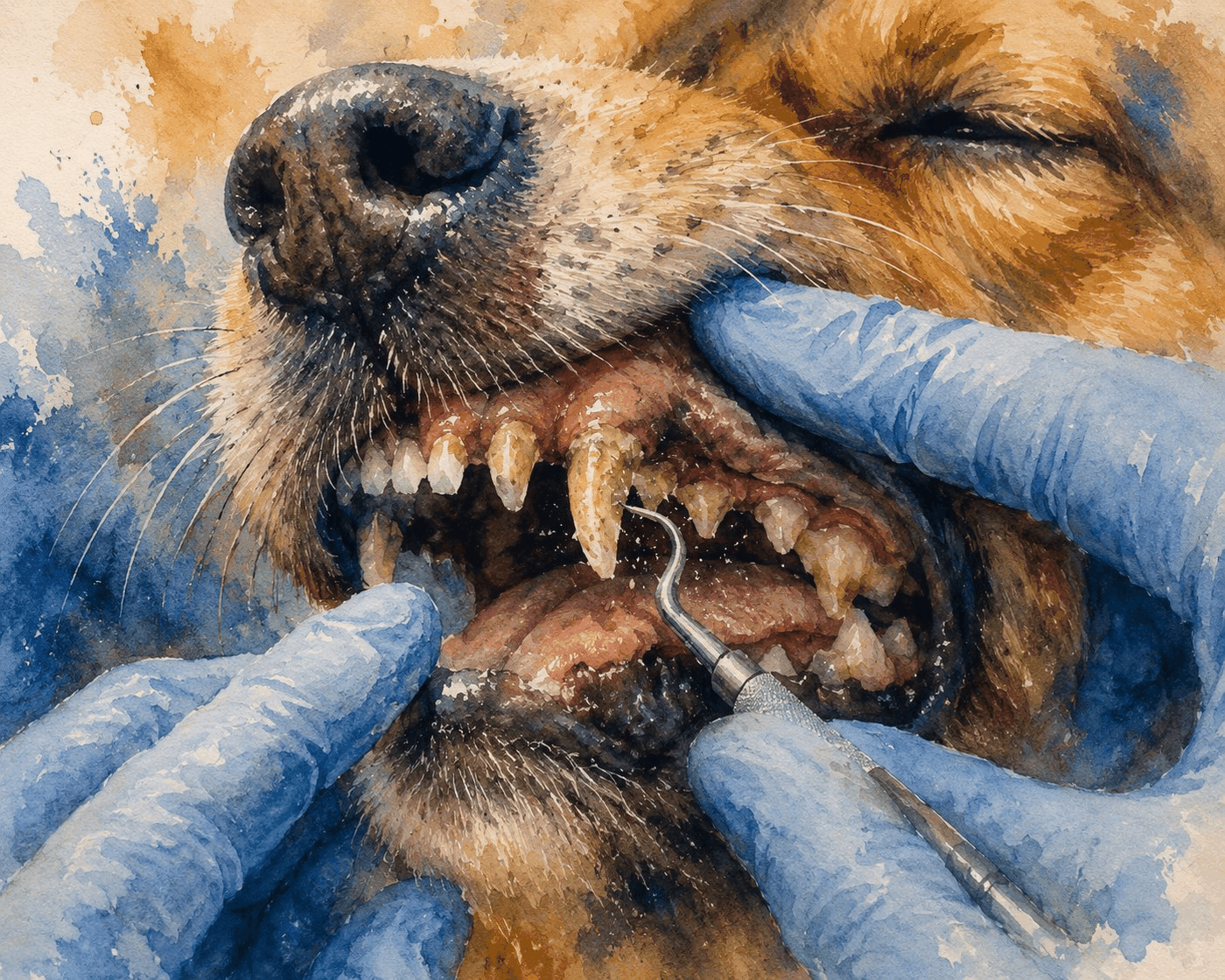
Short for Comprehensive Oral Health Assessment and Treatment — the foundation of every visit. Full-mouth digital radiographs, scaling above and below the gumline, polishing, periodontal probing, and a written exam. No step skipped.
The visible polish is the least of it. Most of what matters happens below the gumline, where disease quietly accumulates with no outward sign until it’s well advanced.
A note on bloodwork.Pre-anesthetic bloodwork is offered separate from the package, recommended based on age and health. The most common panel used is $135. Your doctor will recommend only what makes clinical sense.
What each part of a visit entails.
The COHAT above explains the foundation. These are the clinical disciplines that make a thorough dental visit safe and complete — what they are, why they matter, and what we won’t compromise on. Prices live below.
There is no safe or effective alternative to anesthesia for thorough veterinary dental care. Sedation-free cleaning removes visible tartar but does not allow for subgingival treatment, periodontal probing, or full-mouth radiographs. A conscious, uncomfortable animal will not allow meaningful examination of painful areas.
Every patient receives an individualized protocol based on age, weight, breed, and health history. Advanced monitoring — heart rate, blood pressure, oxygen saturation, respiratory rate, temperature, and end-tidal CO2 — runs throughout every procedure. Endotracheal intubation is standard.
Two-thirds of every tooth is below the gumline. Root abscesses, root fractures, bone loss, and resorptive lesions are completely invisible on visual examination — and yet they are among the most common sources of discomfort we find in dogs and cats.
We take full-mouth films on every patient at every appointment — not spot views of areas that look concerning. A tooth that appears normal from above can harbor an abscess at its root, a fracture through its core, or disease eating it from the inside. We have found significant pathology in teeth that looked completely healthy on the surface.
Periodontal therapy treats the structures that support the tooth — the gum, the ligament, the bone. Without it, a dental cleaning has limited clinical value: the surface looks better while the disease underneath continues.
The work centers on the pocket — the space between the gum margin and the tooth root. When that pocket deepens, bacteria accumulate where brushing and visible scaling cannot reach. Left alone, the cascade is predictable: pockets deepen, bone resorbs, teeth loosen, infection spreads into the bloodstream.
Extractions are the most common dental surgical procedure in companion animals — and the one that provides the most immediate relief. Many pets carry dental disease longer than their owners realize, because it develops quietly below the gumline. When a tooth needs to come out, removing it is almost always the turning point. Owners notice the change within days.
A dog’s teeth and a cat’s teeth are not human teeth — some are larger, deeper, and more firmly anchored; others are smaller, sharper, and more fragile. Both require specific instruments and specific approaches. We carry a comprehensive selection of precision extraction tools, including instruments that sever the periodontal ligament cleanly rather than removing bone to gain access. When something exceeds our scope, we refer to the right specialist — plainly and honestly.
Your pet is already here, already under anesthesia, already cared for. While we’re at it — when it makes clinical sense, we can address other needs in the same appointment. Vaccines for dogs and cats (core and non-core), and targeted products when medically indicated.
Optional add-ons — Periovive ($40), Oravet ($60), Sanos ($160), ReGum ($185) — are offered only when there’s a real clinical benefit, never as a default.
Pricing.
Every surgical package includes the cleaning.
Most people schedule a dental directly, and that works fine. A quick visit first has its own benefits — we can see if your pet would benefit from pre-medication to ease anxiety, review any recent labs, and plan the procedure day more precisely.
It is not required, never a gate, and never a sales pitch. Either way works.
A complete diagnostic and treatment procedure — not just a polish. Every patient receives this; surgical packages are built on top of it.
What’s in every COHAT:
- Sedation and anesthesia with full monitoring (heart rate, blood pressure, oxygen, respiration, temperature, end-tidal CO2)
- Full-mouth digital radiographs — not spot views
- Scaling above and below the gumline, with subgingival debridement
- Periodontal probing and full charting
- Polishing and a written oral exam at discharge
Two-thirds of every tooth is below the gumline. A cleaning without radiographs misses the disease that lives there — which is where most dental disease actually develops. More on what radiographs find →
Cleaning plus straightforward extractions. Includes the full COHAT, local nerve blocks, pain management, watertight closures, and the re-check.
Most first-time patients fall here. Mild to moderate periodontal disease is the most common finding, and a few well-placed extractions usually relieve the underlying source.
Cases that need additional skill: fractured teeth with intact, healthy roots; repeated surgical sectioning; larger gingival flap closures; or anatomy that makes extraction technically demanding.
Difficulty — not quantity — determines the level. A single difficult tooth can place a patient here.
At-or-near full-mouth extractions with significant soft tissue work to repair defects. Common in patients with advanced, long-standing periodontal disease.
Almost always identified at the exam. Rarely a day-of surprise — we’ll usually have seen this coming and discussed it with you in advance.
Bloodwork is offered individually rather than as a single package. A young, healthy pet may need only a basic screen; an older patient, one with weight loss, or one with known health concerns benefits from a broader panel. The most common panel used is $135.
Common options include a panel with kidney and liver markers only, a small or complete metabolic profile, a CBC (Complete Blood cell Count), and ancillary tests like T4, BNP, or glucose when clinically indicated.
Many patients arrive with recent labs from their primary vet — we don’t want to charge you for something you’ve already done. Better diagnostics mean a safer procedure, not just a longer invoice.
Your pet is already here, already under anesthesia, already cared for. When it makes clinical sense, we can address other needs in the same appointment — vaccines (core and non-core) and a few targeted services when medically indicated.
One trip. One nap. Everything handled. We’ll mention it if it applies; we won’t push it if it doesn’t.
Each of these is offered only when it offers real benefit — never as a default upsell.
0.8% hyaluronic acid gel applied to treated tissue during surgery. Accelerates healing, supports bone formation, reduces post-operative discomfort. Used in nearly all surgical cases.
A weekly at-home plaque-prevention gel applied along the gumline — one $60 tube is roughly a two-month supply. Disrupts the biofilm that re-forms plaque after a cleaning, extending the COHAT benefit between visits.
Professional subgingival sealant applied at the end of a cleaning. Seals the gumline against plaque for up to six months. No take-home maintenance. VOHC Accepted.
Biodegradable gelatin scaffold placed into periodontal defects after extraction. Provides a framework for the body’s own bone and tissue regeneration. For cases with significant bone loss only.
Patients over 100 lbs require more anesthetic drug volume, longer recovery monitoring, and extra hands for safe positioning. The fee covers the additional resources — not a difference in care quality.
A short visit a couple of weeks after surgery to confirm everything is healing as expected. Always included — never a separate charge.
At drop-off you tell us your preference: pre-authorize a range and we proceed within it, or email as needed when findings exceed the estimate. Nothing beyond your range happens without your approval.
We accept CareCredit and Scratchpay. If cost is a concern, ask at drop-off — we’d rather build a plan than have you defer care.
One craft. Less overhead. Better pricing.
Most general practices do dentistry alongside everything else they offer — and some have dedicated dental departments that do it very well. We chose a narrower path in Fort Collins: one craft, purpose-built workflows, focused continuing education, and less overhead. The structural savings go to you, and the focused attention shows up in the work.
Every practice is its own business with its own reasons for the way it prices. Trust your veterinarian. Ours just happens to be built differently — and that shows up in both the work and the bill.
Have questions? We’re here.
Exams are always free if you’d like one. Most people book a dental directly.